
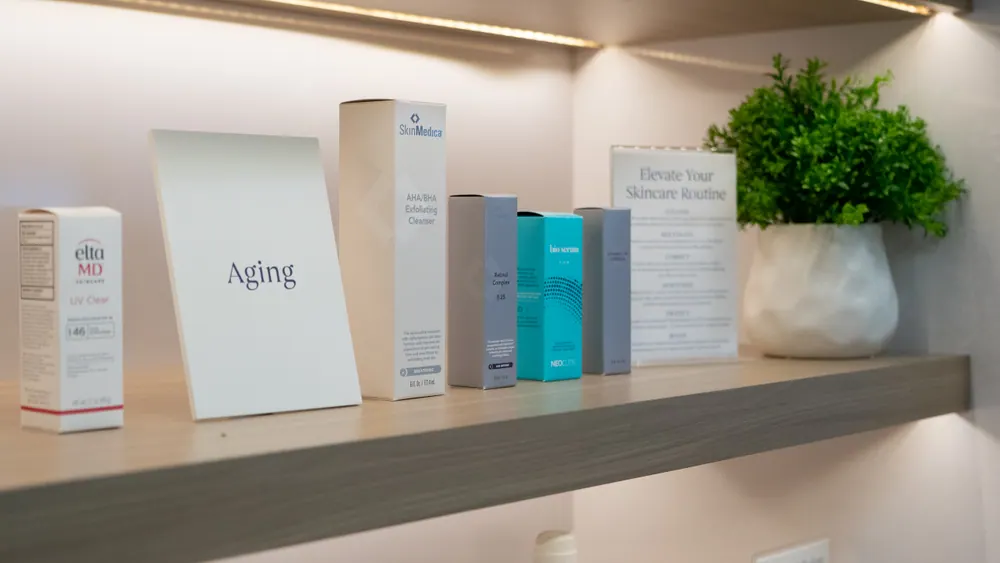
Peptides are having a moment on every shelf and every feed, which is usually the point at which it becomes hard to tell what an ingredient actually does. Here along the Bay, where light comes off the water at Davis Islands from two directions and the humidity settles in before ten in the morning, that question has a practical edge. Skin in this city is repairing constantly. So it is worth knowing what peptides contribute to that repair, and what they do not. At Esthetica MedSpa Tampa on Dale Mabry at Kennedy, they come up in consultations most weeks now, and the honest answer is more specific than the packaging.
What a Peptide Actually Is
Peptides are short chains of amino acids, and their role is communication. Rather than acting on the skin directly the way an acid or a retinoid does, they carry instructions to skin cells. As the Aesthetics Journal's special feature on peptides in skincare describes, their value lies in signaling to fibroblasts — the cells responsible for producing collagen — encouraging behavior that supports firmness and smoothness.
The distinction is worth holding onto, because it explains both the appeal and the limits. A peptide is not doing the building. It is asking the skin to build, which means the result depends on what your skin is still capable of doing. That is a gentler proposition than most actives, and a slower one.
There is a Tampa-specific reason for the interest, too. Formulations built around peptides tend to be lightweight, which matters in a climate where a rich cream applied in August feels like a mistake within ten minutes. A serum that layers cleanly under sunscreen is a serum you will still be using in September — and consistency is most of the game with an ingredient that works by accumulation.
Where Peptides Sit With Sun Damage
This is where expectations need to be set carefully. Years of cumulative UV exposure — the ordinary inheritance of living here — show up as uneven tone, lost bounce, and fine lines that settle in earlier than they might elsewhere. Peptides support the skin's own maintenance of collagen and elastin, the structures that give skin resilience. What they do not do is reverse structural photodamage that has already accumulated. Anything promising that is describing a different product than the one in the bottle.
That is not a knock on the ingredient. Supporting ongoing repair is genuinely valuable in a place where the demand on skin never really lets up. It is simply a different job from correction, and the two are often blurred in marketing.
Pairing Homecare With In-Office Treatment
The most useful way to use peptides is alongside professional treatment rather than instead of it. When the surface has been renewed, topical products meet skin that is primed to respond.
Patients at Esthetica MedSpa Tampa often follow microneedling or a chemical peel with a peptide-focused homecare plan mapped out by their provider. The controlled renewal from those treatments creates conditions in which supportive ingredients can do more. BroadBand Light (BBL) works on a different problem — visible pigmentation from sun exposure — while homecare continues quietly on overall skin quality. And the gentle resurfacing of a DiamondGlow or a HydraFacial leaves skin better able to take up what you apply that evening.
The pattern is consistent: professional treatment resets, homecare maintains. Neither does the other's job well.
Fitting Peptides Into a Tampa Routine
- Apply a peptide serum to clean, slightly damp skin in the evening, when the temperature and the humidity have both dropped
- Seal it with a light moisturizer rather than an occlusive one, which in August will simply sit on the surface
- Finish every morning with broad-spectrum SPF 30 or higher; supporting repair while UV continues unchecked is working against yourself
- Give it months, not weeks, and judge it on how skin behaves over a season rather than overnight
- Rinse off salt water and chlorine before the barrier has to deal with them all afternoon
The Case for a Shorter Routine
The elaborate ten-step regimen is receding, including among the most committed enthusiasts in Ybor City and Seminole Heights. NewBeauty's reporting on K-beauty trends replacing the ten-step routine describes a shift toward streamlined rituals built on a few genuinely effective, multi-tasking products.
Peptides suit that shift well, since a single well-formulated product can address firmness support, hydration and barrier strength at once. The Tampa case for simplification is even more straightforward than the aesthetic one: a routine with nine steps does not survive a humid morning and a commute. A routine with four does, and the one you actually complete is the one that works.
Why It Builds Slowly
Peptides coach skin rather than force it, so visible change arrives progressively as collagen support and texture accumulate. Providers at Esthetica MedSpa Tampa are direct with patients about this, because the alternative is someone abandoning a reasonable product at week three.
Used consistently after a course of professional treatment, alongside real sun protection, peptides can contribute to skin that looks more rested and more even over several months. That is a modest claim, and it is the accurate one. In a market full of overstatement, knowing what an ingredient is actually for is most of what separates a routine that works from a drawer of half-used bottles.
Curious where peptides — or anything else on your shelf — fit your skin specifically? Schedule a free consultation at Esthetica MedSpa Tampa on Dale Mabry at Kennedy. Our team will look at your skin, ask what you are already using, and give you a written plan built for this climate rather than a generic one.
Educational content, not medical advice. Individual results vary; candidacy is confirmed by a licensed provider at a free consultation.